July 23, 2026 | Ellen McGuyer
Why Selling to K-12 Schools Requires Education-Specific Data
Companies entering the K-12 education market often discover that familiar B2B targeting methods do not translate neatly to schools and districts.
Education organizations have specialized job roles, layered purchasing processes, distinct planning cycles, and highly protected email systems. These differences affect not only who marketers should contact, but also when and how they should reach them.
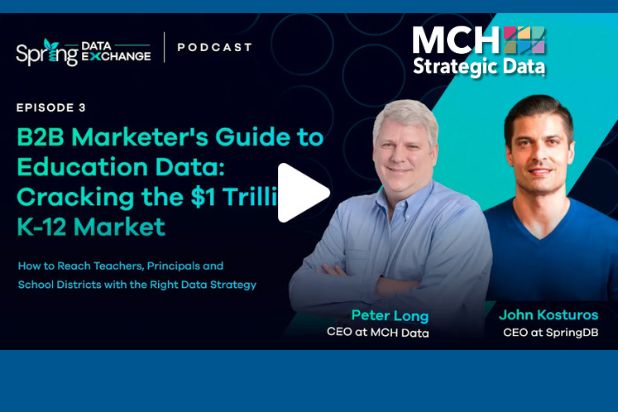
MCH Strategic Data CEO Peter Long recently joined John Kosturos on the SpringDB Data Exchange Podcast to discuss what makes education data different and what companies should understand before marketing or selling to K-12 organizations.
Explore the full conversation and key takeaways from the podcast.
School Roles Are More Specialized Than Corporate Titles
Most general business databases organize contacts around familiar functions such as executive leadership, finance, operations, human resources, and sales.
Schools and districts include those functions, but they also contain highly specialized education roles. Depending on the organization, marketers may need to reach classroom teachers, curriculum leaders, special education staff, technology administrators, principals, transportation directors, food service personnel, purchasing teams, facilities staff, or district executives.
Titles also vary considerably between schools and districts. One person may perform several responsibilities, while similar jobs may be described differently from one organization to another.
Effective K-12 targeting therefore requires more than searching for a familiar corporate title. It requires education-specific job-function organization that connects varied titles to the responsibilities relevant to a product or service.
Deliverable Email Does Not Always Mean Accurate Data
An email address can continue working even when the information surrounding it has changed.
An educator may move to a different grade, subject, department, school, or administrative role while retaining the same district email address. The message may reach a real person but still reach the wrong audience.
For K-12 marketers, useful contact data must reflect what a person currently does, where that person works, and how the role fits within the institution. That requires ongoing research and verification of personnel, positions, and organizations—not only checking whether an email can be delivered.
MCH combines web research, human review, and direct verification as part of its ongoing education data maintenance process. More than 5 million education contact records are updated each month through these processes.
The Buyer May Not Be the Person Who Places the Order
School purchasing decisions frequently involve several stakeholders.
A teacher may identify a classroom need. A curriculum leader or department chair may evaluate possible solutions. A principal or district administrator may approve the expense. Purchasing staff may then process the transaction.
This means an order record may identify the person who completed the purchase without revealing who first selected, recommended, evaluated, or approved the product.
Successful education marketing often requires reaching several members of the buying group with messaging appropriate to each person’s role in the decision.
School Email Systems Require Careful Deployment
Even a well-selected education audience can be difficult to reach when campaign deployment practices are not designed for school environments.
District email systems protect large networks of staff and students from phishing, ransomware, spam, and other threats. Sending a large number of similar messages into a single district domain can trigger filtering or blocking across the organization.
Education email campaigns should use focused segmentation, controlled volume, domain-level throttling, proper sender authentication, and messaging that is relevant to the selected recipients.
In this environment, a larger list is not automatically a better list. A smaller audience closely connected to the offer can produce stronger engagement while reducing unnecessary pressure on sender reputation.
Timing Matters as Much as Audience Selection
K-12 purchasing activity is influenced by budget approvals, school-year transitions, staffing changes, curriculum adoption schedules, grant deadlines, testing periods, and back-to-school planning.
A campaign can reach the correct decision-maker but still arrive outside the period when the organization is researching, budgeting for, or purchasing a solution.
The strongest K-12 marketing strategies connect audience selection, message relevance, and institutional timing rather than treating them as separate campaign decisions.
A Closer Look at Education Data and K-12 Marketing
In the SpringDB Data Exchange Podcast, Peter Long and John Kosturos discuss education job roles, school purchasing groups, contact-data changes, district email security, market timing, CRM enrichment, sales prospecting, and programmatic audience development.
Read the key takeaways and watch the full SpringDB education data conversation.
MCH Strategic Data helps companies identify and reach schools, districts, administrators, educators, and other K-12 decision-makers. MCH education data supports email marketing, direct mail, sales prospecting, account-based marketing, CRM enrichment, market analysis, and programmatic audience development.





Need More Time?
Due to inactivity, you will be logged out within 5 minutes.
To stay logged in, please select Stay Logged In.
 Logout